Musicians who said the mushroom out loud
Margo Price took a bag of mushrooms to a rental house and came back with Strays. What a church journal can learn from musicians who said the word in public, and what it refuses to borrow from them.
In January 2023, Consequence published Jonah Krueger's interview with Margo Price about her album Strays. She had gone to a rental house in South Carolina with her husband and a bag of mushrooms and come back with a record she described as a journey with peaks and valleys. We are not going to replay her quotes as if they were ours. We are going to talk about why a church journal bothers with a country singer at all, and about the line between noticing a song and borrowing a famous mouth.
The reason is simple. Culture already said the word. Musicians have been saying it in public for years, in interviews and liner notes and songs, and a sanctuary that pretends otherwise sounds like a pamphlet. A sanctuary that pretends to be a music magazine steals. We want the third thing: to notice the song, refuse the lift, and go back to the kitchen.
Who has said it
Price is the most recent clear case, and the most useful, because she talked about process rather than mystique: a place away from the usual life, a partner she trusted, and a body of songs that came out of the weeks after, not the hours during. Father John Misty has talked about mushrooms for a decade in the way he talks about everything, half confession and half joke. Chance the Rapper has spoken about LSD, which is a different compound and a different conversation, but the same public willingness to name the thing.
Those names were already gathered in a 2018 review in The New Yorker of the books then being called the psychedelic renaissance, alongside Timothy Leary, Michael Pollan, and Tao Lin. The renaissance is a magazine story. The kitchen is our story. They touch at exactly one point: the moment a person admits, in public, that a night changed the work. That admission is worth something, and we want to be careful about what.
What an interview can teach a congregation
An interview has turns. A question, then a refusal to stay in one lane. Price told Krueger she was trying to veer out of the country world, and the record she made did. That turn is useful to us as a shape, not as gossip: a sacrament that only knows one mood is a sacrament that will bore a person into taking more than they meant to. A night, like a record, needs more than one register.
She also talked about staying away from alcohol during that time while the people around her were not. Abstaining inside a scene is a discipline, and discipline is the part of her story we recognize. We do not understand her life, and neither do you. Do not use a profile as a map for your own night. Use it as proof that adults already speak this language in rooms that are not ours, and that some of them speak it carefully.
The interview ran long, six pages on the site. The length is its own lesson. Culture takes time. A chorus is not a paper. A paper is not a bar. Keep the genres in their houses and visit them on purpose.
What we will not become
We will not become a playlist blog, and we will not rank albums as if ranking were a sacrament. We will not pretend that because a singer had a night, our chocolate is invited onto the tour bus. Tour buses have their own chaplains, and we are not applying.
We will not use a famous name to wash a batch. If a musician ever sits at our table, we will say so when it happens. Until then, the names in this essay live in the public record and stay there, and the only name on our foil is our own. Fame is a solvent; it dissolves caution. A singer says a word on a press day and a thousand kitchens try to bottle the quote. Clean foil is a cultural position. It says the work can stand without a famous mouth attached.
And we will not reprint a lyric as a verse we own, a press-cycle quote as liturgy, or another magazine's opening paragraph about Price or anyone else. If you recognize a sentence here from a glossy, tell us and we will cut it.
What the renaissance story gets right and wrong
The 2018 review in The New Yorker read three books at once and treated the whole thing as a literary phenomenon: Leary's old provocations, Pollan's careful reporting, Lin's diary. It got one thing right that most trend pieces miss. It noticed that the interesting writing was the writing that stayed specific: a named session, a named room, a named morning after. The general claims aged badly within a year. The specific ones still read.
What it got wrong, from where we stand, is the frame. A renaissance is a story about culture catching up to a molecule. A sanctuary is a story about people catching up to themselves, one night at a time, with a batch number on the wrapper and a list on the fridge. Those stories overlap but they are not the same, and a church that lets the magazine frame swallow its own will start writing about trends instead of about batches. We would rather write about batches.
So when a new book or a new profile lands, we read it the way we read Krueger's interview: for the specific, and for the discipline. If a musician or a writer describes the room they chose and the morning they kept, that is worth passing on. If they describe a revelation with no room around it, we let the magazine have it.
Why culture is a desk in this Journal
A church journal about the sacred mushroom could easily sound like two pamphlets stapled together: the clinic's warnings and the shop's promises. Culture is the desk that keeps it from becoming either. A record, an interview, a review, honestly read, is proof that this conversation already happens among adults in public, in their own words, without a church or a clinic in the room. That is a steadying thing to remember on both sides.
It is also the desk most likely to steal, which is why the never-copy rule exists for this page especially. Another publication's lede is theirs. A lyric is the writer's. A quote from a press day is a quote from a press day, and putting it in a purple frame does not make it liturgy. Everything on this desk is either our own sentence or a named citation you can go and read for yourself.
What culture cannot do is make a night safe or a batch honest. Those are the safety essay and the kitchen essay. Culture is the part of the Journal you read after, with the record on, when the question is no longer what to take but what it meant that someone else said the word first.
Music and the night, as members describe it
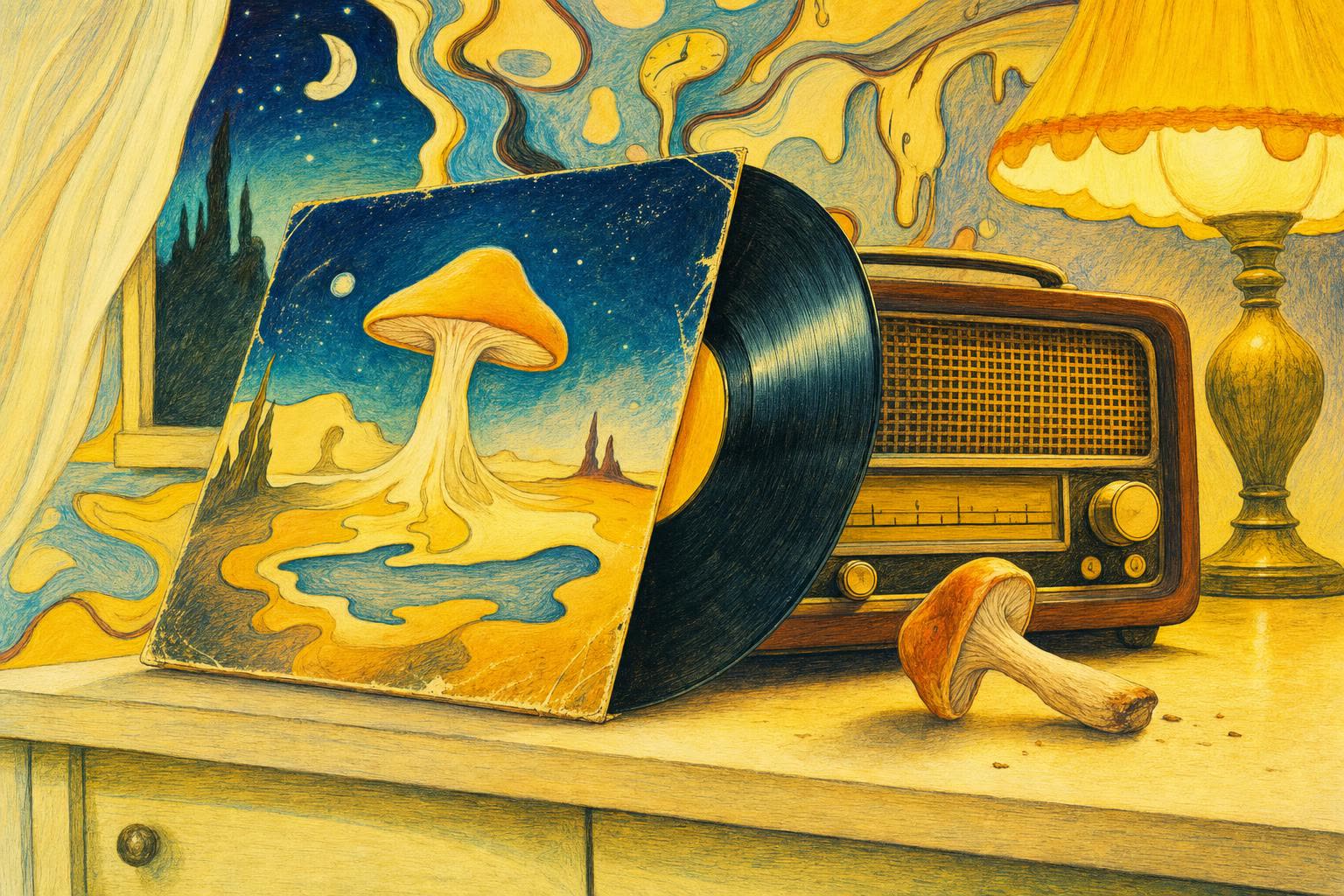
Members write about music more than about any other part of a night, and what they describe is consistent enough to be worth passing on. At the walk, one to three pieces, music tends to sharpen; people hear the room around an instrument. At the run, four to seven, it tends to open; a song they have heard a hundred times has a door in it they had not noticed. At a flight, eight to ten, many people stop being able to follow a song at all and want either silence or something with no words. None of that is a claim about what the sacrament does. It is what people tell us, and the dosage guide says the same about the whole framework: experiential observations, not medicine.
The one piece of practical advice that survives every letter is this: choose the music before the night, not during. A person searching a streaming library at the run is a person who has lost the thread of their own evening. Make the list at noon. Make it long enough that you never have to touch the phone. Then let it play, or turn it off, and let the room be the room.
One more thing members mention, which we pass on without endorsing any record: the song that opens a door at the run is almost never the song you expected. People plan the profound album and end up undone by something plain that was already on the list. Make the list wide. Let the night choose from it. That is as close to a recommendation as this desk will come.
Silence is underused. So is a walk with no music at all, which is still the best integration tool we know that does not require a license.
How to listen from the sanctuary
Listen first as a person, then as a maker. If a record makes you want to pour a better batch, write a truer paragraph, or call someone you have not called, that is a good use of culture. If a record makes you want to take more than you planned, that is a bad use of culture, and the difference is in your body, which we cannot hear from here.
Put the record on after the sacrament, not instead of the walk. Music is allowed on the walk. So is silence. Psibyl, the guardian we drew for this church, is not a musician; she is a listener, which is the older skill, and the one this essay is really about.
If a song sent you to this church, we would like to know which one. Not to put it on a shirt. We keep a list so the Journal stays in conversation with the world that already said the mushroom out loud, and so that the next culture essay is about the next honest interview and not about a trend piece.
The public record is enough
You do not need us to interview Margo Price, and you do not need us to get a quote nobody else has. Strays exists. The Consequence interview exists and is findable. The New Yorker review exists. Three objects, none of which requires a backstage pass. A kitchen that noticed a musician used the word without whispering, and then went back to weighing cacao, has done its whole job.
The lesson people want from her story is: take mushrooms, make a record. The lesson we will keep is: she already had a craft, a band, a history of work, and then she had a night. Nights do not replace catalogs. Catalogs do not require nights. Confusing the two is how a fan ends up in a rental house they cannot afford, waiting for an album that was never going to arrive that way.
If you love that record, buy it from her. Do not buy our bar as a tribute; tribute bars are embarrassing. Eat our bar because you wanted chocolate from this kitchen, and play her record because you wanted a song. Two receipts, two rooms, and the door between them is one you get to walk through on purpose. Write to sanctuary@mail.herochurch.org if you want to tell us the song.