Set, setting, age, and what we will not claim
Safety is not a waiver dressed as an essay. It is a short list of rooms we will not enter, a longer list for your fridge, and the claims you will never find on our wrapper.
Safety pages usually fail in one of two ways. They scare you until you click away, or they soothe you until you stop thinking. This is an attempt at a third page: one that names the rooms we will not enter, hands you a list you can tape to a fridge, and then stays quiet enough that you can hear your own judgment.
Set is the mind you bring. Setting is the room, the people, the phone you did or did not silence. Age, for us, is twenty-one and over. Those three words do more work than a thousand disclaimers. If you are not an adult, this Journal is not for you. If you are an adult and you are in a bad room, the chocolate will not fix the room.
The words we inherited
Set and setting is an old phrase. Timothy Leary popularized it in the 1960s, and it traveled a great deal farther than his caution did. Norman Zinberg wrote it down properly in 1984, in a book called Drug, Set, and Setting, which is still what people quote when they want a shorter word than context. Zinberg's point was plain: the same substance produces very different nights depending on who takes it, what they expect, and where they are. Sixty years later that remains the single most reliable finding in the field.
We did not invent the phrase and we will not trademark it. We use it because adults already search for it, and because it is still the most accurate description of what matters. We do not use it as a blessing. A blessing would imply we supervise your set. We do not. We are a kitchen and a congregation on the other side of a screen, and a website is not a sitter.
The five rules on every wrapper
The dosage guide carries five lines and they are the same five on the wrapper. For use by persons twenty-one years of age or older. Consult your physician before use, especially if you take psychiatric medication or have a mental health condition. Do not use if pregnant or breastfeeding. Do not drive or operate heavy machinery after use. Keep out of reach of children, and keep the poison control number, 1-800-222-1222, where you can find it.
Each one is a room we will not enter with you. We will not tell you what to do about your prescription; that is a physician's room. We will not tell you the sacrament is fine in pregnancy; nobody honest can. We will not tell you that you can drive; you cannot. And we will not tell you a dose that is right for your body. We print what is in a batch. Your body is not in our ledger.
The age line deserves its own sentence, because it is the one people try to negotiate. Twenty-one and over is the law we will not decorate. It is also the line we ask every member to affirm, in their own words, when they join. If you are under it, this page is not for you. If you are over it and lying about a friend who is not, you have already failed the list.
Why joining the church is part of safety
Before a first order, every member reads and confirms one statement about their age and about what they are receiving. The words of that statement are not written by a copywriter. They come from the access policy we publish, they carry a fingerprint, and if the policy changes the site asks you to read the new words before it lets you continue. That is deliberate. A safety promise that can be quietly edited is not a promise.
The affirmation is also the moment the safety list stops being a page you might have skipped and becomes something you said. We would rather a member pause for a minute at the door than discover the age line on the wrapper after the fact. Membership is free and it obligates you to nothing. It obligates us to know who is at the table, which is the least a sanctuary can do.
Mixing, and the rooms we will not enter
We will not tell you to mix the sacrament with alcohol, with lithium, with anything that touches the same receptors, or with a night you already know is too loud. Alcohol in particular blurs the one instrument you need most, which is the sense of when enough has arrived. If your plan for the evening includes a drink, make it a different evening.
Medication is a physician's room, and we mean every word of the second rule. A psychiatrist can tell you what your prescription does to the night and what the night does to your prescription. We cannot, and a church that pretends to is practicing medicine without the one thing that makes medicine safe, which is accountability for the bad night.
We are not your sitter. A sitter is a person in the room. A website is a person far away with a keyboard. Do not confuse us, and do not let a warm sentence on this page stand in for the friend who should be on the sofa.
What a good night looks like from here
A good night has water on the table before the wrapper comes off. It has food you will actually eat later, not a performance meal: a banana, bread, leftover rice. It has a person who knows where you are and what you took, ideally in the room, at least a phone call away and expecting the call. It has a time you have protected, and no meeting at eight in the morning that you are pretending you will crush.
A good night has an exit. Exit means you can stop. You can go outside. You can say the word enough and have someone hear it. If your room has no exit, do not add a sacrament to it. That is not morality; it is architecture.
A good night, if it includes our chocolate, includes reading the label as if it were a recipe and not a spell. Recipes have amounts. The label has a piece count and a batch number, and the dosage guide turns the count into a map: one to three pieces for a walk, four to seven for a run, eight to ten for a flight. Start with the walk if you have never been here. You can always take another piece later in the evening. You cannot take one back.
A fridge list, in case you skip the rest
Adults only. A named batch. Water. Food. A person who knows the address. A night without a morning performance. A room with an exit. A phone that can call for help. A plan for when the story wants to get bigger than the night. That is the list. Tape it somewhere you will see it when you are already committed to being kind to yourself.
If any item on that list is missing, the missing item is the work. Not the dose. Not the brand. Not this essay. Fix the room first. The kitchen will still be here when the room is ready, and so will the shop.
Order matters. Water first, because water is boring and it is the item people skip when they feel ready. Then food. Then the person. Then the exit. Then the phone. Then, if all of that is true, the wrapper. The wrapper is last on purpose. Last is how you stay an adult.
After, when the story wants to get bigger
Afterward the story will want to get bigger than the night. That is normal. Write the night down before you give it a thesis. If it was hard, tell someone who can sit with hard things. If it was easy, do not immediately double the count to chase a feeling. Easy is allowed to stay easy.
If something is medically wrong, you need medical help, and the poison control number is on the wrapper for that reason. If something is spiritually loud, you may need a congregation, and that is a thing we can be. We cannot be an emergency department. The distinction is the whole ethic of this page.
The morning has its own short list. Water again. A real breakfast. A walk that is longer than the parking lot. Then, if you want to keep anything from the night, write it down in plain sentences before you tell it to anyone, because the first telling tends to add a moral the night never had. A note written at nine is worth more than a story told at eleven.
Optimism is a beautiful liar. It tells you the room is safer than it is because you like the people in it. Liking someone is not a sitter. Liking someone is not an exit. Keep the list anyway, especially when you like everyone in the room. The room is the test, and we will not take it for you.
What we will not claim on a label
We will not claim the sacrament is lawful wherever you stand. Law is a map that changes at county lines; we ship only where our sacraments are permitted and we ask you to know your own ground before you order. We will not claim clinically proven. We will not claim safe for everyone. We will not claim that a sitter is included. None of those sentences fit on our foil because none of them are true in the way foil needs.
What the foil carries is a batch number that leads to an independent lab's certificate, a piece count, the ingredients, the five rules, and the age line. If we cannot fit those, we have a design problem, and design problems get solved with smaller type. Marketing problems get solved by lying, and we choose smaller type.
If you ever see a claim on a screenshot with our name on it that you cannot find on this site, it is not ours. We do not run a discount code through a safety page, we do not send a coupon with a warning, and we do not follow up to ask whether you taped the list. Safety that turns into a drip campaign is a sin we are trying not to invent.
The closed door on the cover
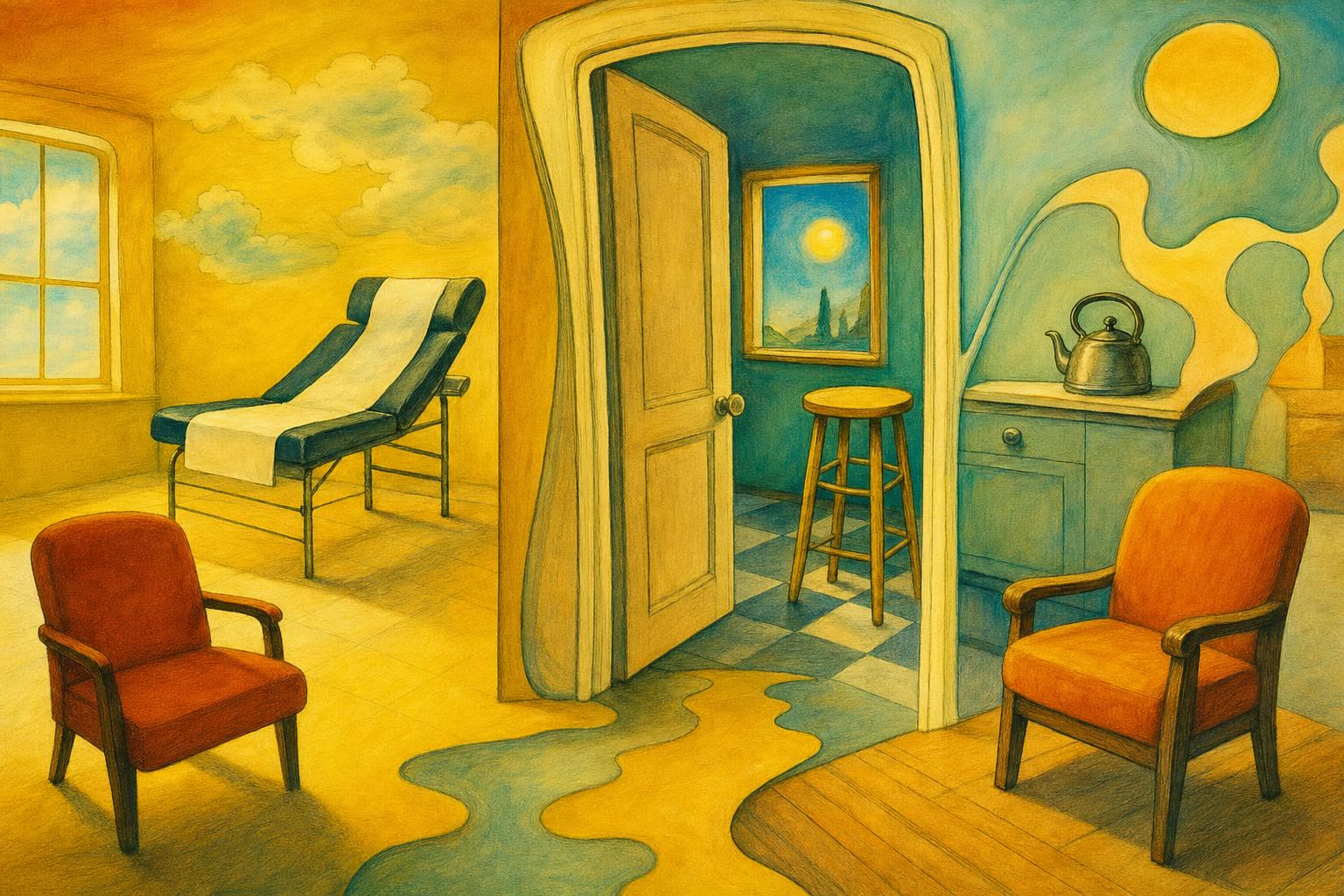
The cover of this essay is a closed door and a shut book. We commissioned it because safety looks like stopping. The welcome letter got an open door, and both pictures are true; they are true on different nights.
Stopping is the skill this page exists to teach. If you cannot do the order, water, food, person, exit, phone, and only then the wrapper, stop. Going home is a successful safety outcome. The kitchen will still be here tomorrow, and tomorrow is a better setting than a proud mistake.
That is the list, and that is the ethic. If a line on it is unclear, write to sanctuary@mail.herochurch.org and say which one, and we will fix the sentence. Unclear is a writing error we can repair. Unwilling is a room we cannot staff. We staff the chocolate. You staff the night.