When the night itself is the work
A night with the sacred mushroom does not hand you finished art. It hands you material, a morning, and a decision. Here is how we think about making, and how we make the pictures for this church.
There is a rumor that mushrooms deliver finished work. It is useful to people who sell shortcuts and useless to anyone who has sat through a night and then tried to draw in the morning. In late 2025, Wholecelium published a long piece arguing that the journey is itself a creative act. We agree with the shape of that argument, and we will not lift their title or their sentences. Agreement is not theft if you do the work of saying it in your own kitchen.
This essay is about that work: what a night gives a maker, what it does not, how the morning is where most of the art happens, and how a church that commissions pictures keeps them honest. It is written for adults, twenty-one and over, and for anyone who makes things and has wondered whether the sacrament is a tool or a trap. Our answer is that it is a material. Materials do not finish anything.
Why the shortcut story is so sticky
The shortcut story is sticky because labor is heavy. If a molecule could skip the years of looking, everyone would buy it. Design blogs have circled the same hope for a decade: fewer constraints, more connective leaps, a mind that associates faster. Sometimes that is true for an afternoon. An afternoon is not a practice.
In 2024, Psychedelics Today ran an essay on how these compounds show up in contemporary design. The useful part of that conversation is the part that admits hyper-association can also be noise. Noise feels like genius at one in the morning and looks like a mess at nine. A church that pretends otherwise will ship messy wrappers and call them visions.
A creative act has materials, time, and a refusal. Materials: the body, the room, the count of pieces, the people you trust. Time: longer than a playlist. Refusal: you do not get to skip the middle where nothing is a painting yet. The middle is the work. Anyone who tells you the mushroom is a vending machine has not been in the middle.
What a night gives a maker
A night with the sacred mushroom, at the dose our guide calls a run, four to seven pieces, tends to loosen the grip of the usual editor. Members describe noticing connections between things that had been filed in separate drawers, a warmth toward their own unfinished ideas, and a willingness to sit with an image longer than the daytime mind allows. That is material. It is real, it is worth having, and it is not a drawing.
What the night does not give is judgment. The same loosening that lets two ideas touch also lets a bad idea feel finished. The people who make good work with this material are the ones who treat the night as a source and the morning as the studio. They write things down without deciding what they mean. They date the page. They go to bed.
At a flight, eight to ten pieces, the heroic dose, most people are not making anything at all. They are being carried. That is its own kind of work, and it is not the kind you can bring to a desk the next day in one piece. We say this so nobody buys a bar expecting a productivity tool. The guide counts in pieces precisely so that a maker can choose the smaller night on purpose.
The morning after is the studio
Water. Food. A walk. Then the desk. If the night gave you an image, test it in daylight. If it cannot survive daylight, it was weather, not a work. Weather is real, and weather is not a portfolio.
We keep saying noon because morning lies and midnight boasts. Noon is when the lamp looks ordinary, and ordinary light is the only light that can judge a thing. If an object needs darkness to remain interesting, it is a night. Keep it. Do not hang it. If it still stands at noon, on a plain table, with the dishes not yet done, then you have something, and only then do you owe it another hour.
The throwaway pile is part of the craft. A maker who cannot throw anything away after a night is a maker who will decorate their life with junk and call the junk sacred. Throwing is the creative act most people skip because it does not photograph well. Keep one page. Throw the rest. The one page is the work.
How we make the pictures for this sanctuary
Every picture on this site was commissioned in daylight, with a brief, and a critic, and a never-list. The gold flower arch with the spiral at its center. Psibyl, the crowned crystal tiger on her plinth among the mushrooms. The two travelers at the gate. The rose, mint, and lavender worlds behind the shop. None of them were produced during a night. They were made by people who took the night seriously and then went back to the desk. That order matters.
The brief is a house style, and it is written down: storybook line, gouache grain, cream and gold with magic-purple depth, one clear subject. The never-list is written down too: no film-stock recipes, no plastic skin, no catalogue posing, no stock mushroom photography on black velvet. When we need a new plate we make several inside that law and throw away anything that looks like it came from a stock library. The pile of rejects is not a failure. It is how a rose world stays a rose world instead of becoming wallpaper of every flower at once.
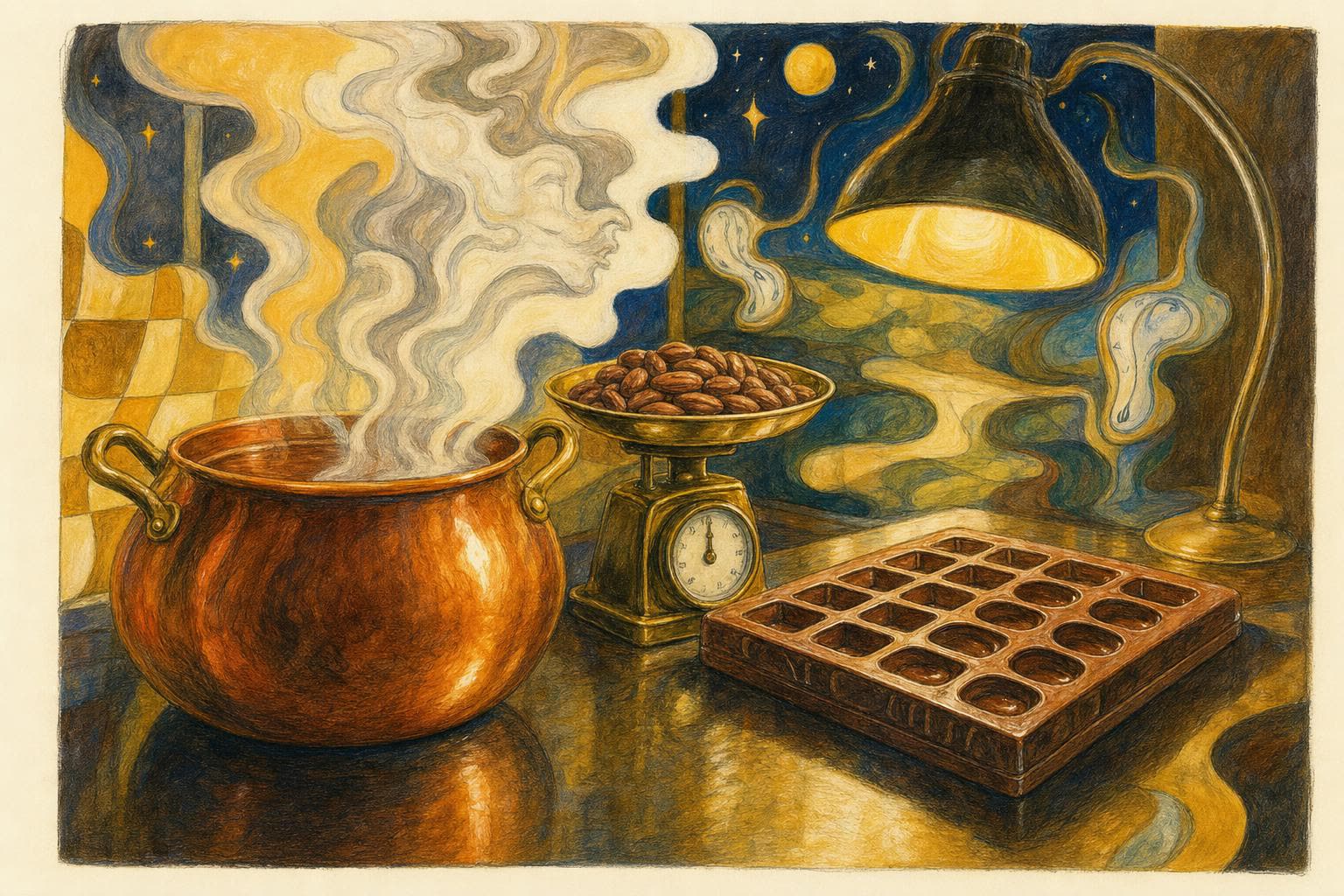
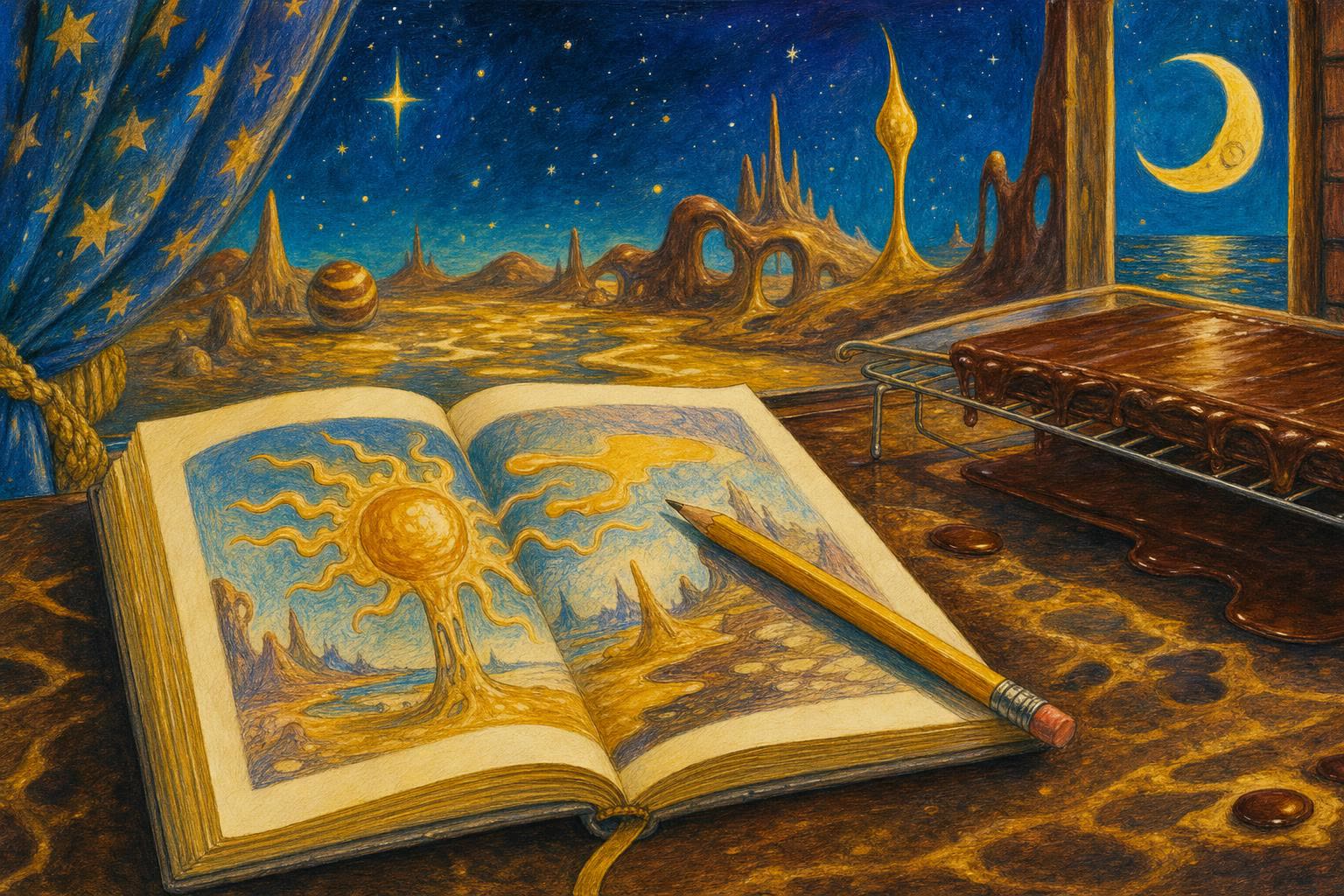
The covers of these essays are commissioned from the essays. The kitchen essay got a kettle and a mold. This one got a sketchbook beside a cooling bar, with bloom on the chocolate, because bloom is what a rushed night looks like on a real object. The cover is not a product shot; product shots live in the shop. A journal is allowed props if it says they are props.
Where the sacrament sits in a practice
A practice is attention given regularly to something worth attending to. Painters have hours. Writers have mornings. Musicians have the hour before a show when nothing else is allowed in. The sacrament is not a practice; it is an occasional visitor to one. Members who make things describe using it the way a photographer uses a long exposure: rarely, on purpose, for a kind of light the ordinary shutter cannot catch, and never as the camera itself.
That means a night is planned around the work, not instead of it. The sketchbook is already open. The instrument is already tuned. The question you are carrying is already written at the top of the page, so that when the night loosens the editor, there is something for the loosened mind to work on. A night with no question tends to answer everything and nothing. A night with one question sometimes answers it, and the answer is usually stranger and smaller than the one you would have invented sober.
And it is not daily. The framework on our dosage guide is a map of nights, not a schedule. A maker who reaches for the smallest dose every morning has confused a material with a habit, and habits do not need a church. The people who get the most from this material are the ones who use it least, with the most intention, and who spend the other twenty-nine days of the month at the desk in ordinary light.
A small assignment, if you want one
Before a night, write three things you will not make. Not moral things, craft things. I will not draw a floating mushroom on velvet. I will not write a sentence that begins with a promise. I will not photograph my own face as proof. The list is yours; the point is to have one, on paper you can still read when you are tired.
After the night, make one object that can sit on a table. A paragraph. A drawing that still makes sense at noon. A bar, if you are a baker. If you cannot make the object, the night was still a night. It does not owe you a portfolio, and nights that are made to owe a portfolio become greedy.
Date both. Dating the page is how you remember it was a night and not a commission. Commissions happen in the day, with a brief and a critic. This Journal commissions its covers in the day. The night does not get to hire us, and it does not get to hire you.
Bloom as a teacher
Chocolate bloom is the white haze that appears when tempering is rushed and the cocoa butter crystals lose the argument. It looks like a mistake. It is information. A night can bloom too: you wake and the story you told yourself has a haze on it. Do not scrape the haze off with a bigger story. Scrape it with breakfast. Breakfast is a better editor than shame.
We know bloom from the kitchen, not from a metaphor. A rushed batch shows it within a day, a dull streak across a square that should shine, and the batch does not ship. We eat it, write the date and the reason in the batch record, and temper the next one slower. The lesson carries over to the desk without changing a word: the haze is not the end of the work, it is the note that tells you which step you hurried.
If your work has bloomed, say so, before someone else calls it rustic for you. The first person to tell the truth about a haze owns the next attempt. Ownership is the only prize we understand, and it is available to anyone willing to look at a plate at noon.
What a night owes you
A night owes you nothing but the hours it already had. It does not owe you a song, a painting, a business, or a healed childhood. If you got any of those, you got a gift, and gifts are not invoices. People who treat the night as a productivity hack end up with a lot of files and a thin life. A thin life is not a style so much as a shortage of noon.
Constraint is not the enemy of wonder. Constraint is how wonder becomes an object another person can hold. One true square of chocolate and one true paragraph are worth more than a hundred noisy ones, and the mushroom, for all it gives, has never once done the choosing.
If you want to show us the one object, write to sanctuary@mail.herochurch.org after noon, and attach one thing. We might not publish it. We might tell you the never-list leaked. That sentence, if we send it, is a gift, because most of the world will not be kind enough to cut.